How it works
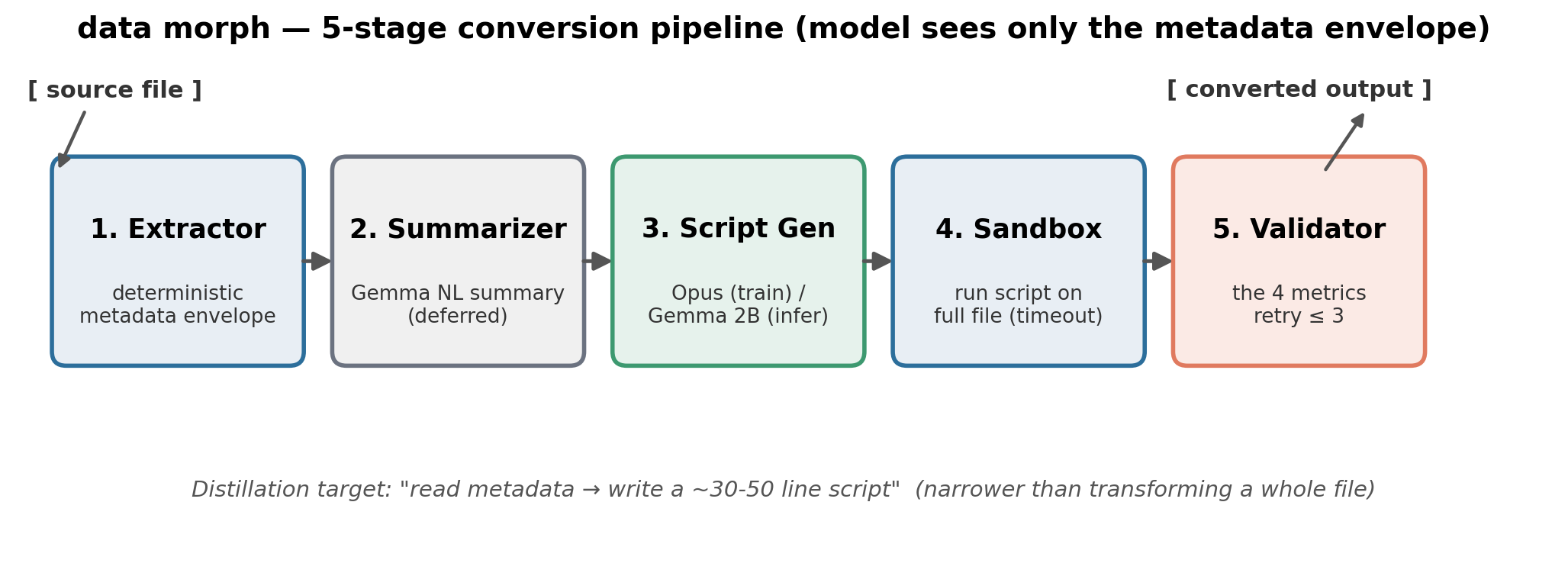
Conversion is a five-stage pipeline, not a single end-to-end model call. The model only ever sees a small structured metadata envelope, never the full source file.
[source file]
    ├─→ 1. Metadata extractor   deterministic — schema + samples + warnings
    ├─→ 2. Context summarizer   Gemma base — short NL summary (deferred)
    ↓
    3. Script generator   Claude Opus (training) → Gemma student (inference)
    ↓ emits an executable Python conversion script
    4. Sandbox executor   deterministic — runs the script (timeout + CPU limit)
    ↓ converted output file
    5. Validator          the four metrics — format, schema, load, content
    ↓
[output file]
- Metadata extractor — deterministic. Produces the envelope: schema, sample values, and warnings (24 rules), for CSV, JSON, and TXT.
- Context summarizer — a short natural-language summary of the envelope. Deferred (an inference-time nicety, not needed to collect training data).
- Script generator — the heart of the system. Claude Opus writes the script during
training; the fine-tuned Gemma student writes it at inference. Output is an
<analysis>block followed by a<script>block. - Sandbox executor — runs the generated script on the real source file in a subprocess with a timeout and CPU limit.
- Validator — scores the output on the four metrics below.
Why this shape
Narrowing the distillation target from "transform a whole file" (impractical for a 2 B model) to "read metadata, write a script" (realistic) is what makes a small local model viable. Because the model never sees full file content, the pipeline scales to arbitrary file sizes, and every conversion leaves a readable, debuggable artefact — the script.
The four metrics
- Format Validity — output loads with
json.load()/csv.reader()/ etc. - Schema Compliance — expected structure / JSON Schema passes.
- Loadability — pandas (or the downstream library) can consume it.
- Content Accuracy — field-level comparison vs. source; no hallucination, no data loss.
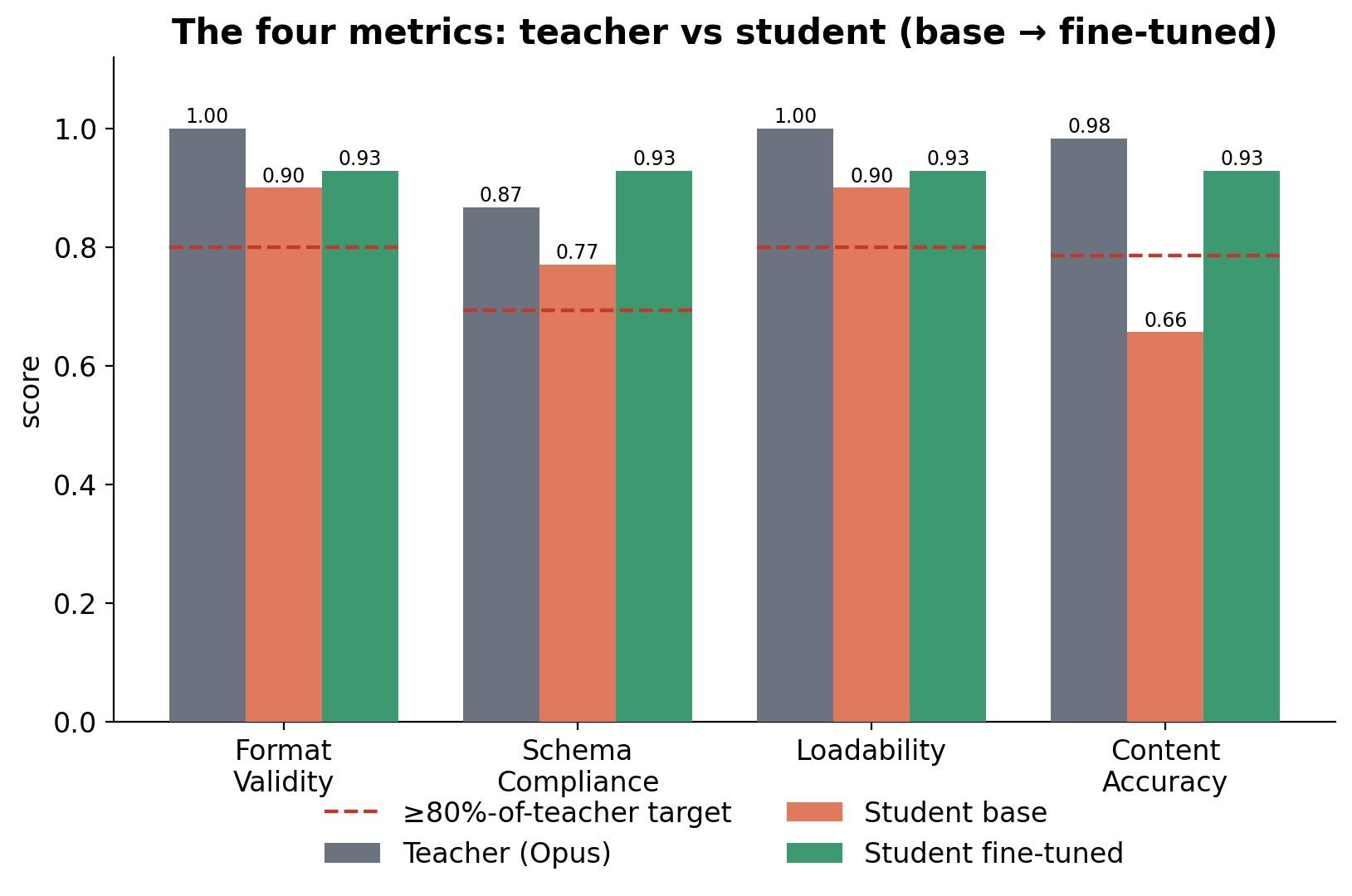
At inference, the public API checks Format Validity + Loadability (no answer key exists for a real file) and retries on failure; training additionally required Schema Compliance = 1.0 and Content Accuracy ≥ 0.95 before a pair was accepted.
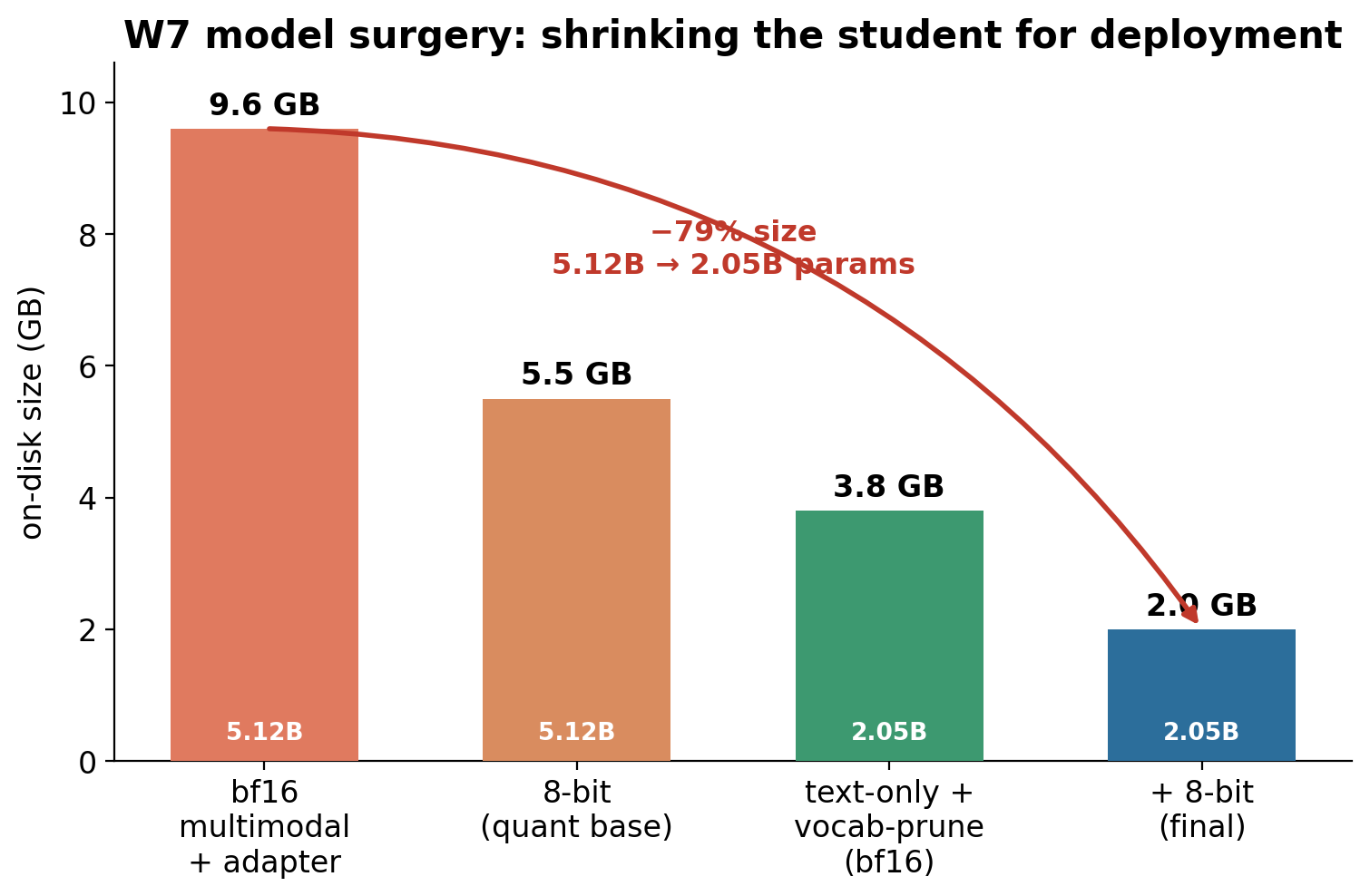
From teacher to a 2.0 GB student
- Teacher: Claude Opus generated 800 programmatically-verified training pairs.
- Student:
mlx-community/gemma-4-e2b-it-bf16, fine-tuned with LoRA. - Compression: fuse the adapter → strip the unused vision + audio towers → prune the 262 k vocabulary to 16 k → quantize to 8-bit.
The result holds ~96 % of teacher accuracy at retry ≤ 3 — above the project's ≥ 80 %-of-teacher target on every metric. The model + training data are public: model · dataset.